
We often see people calling Trump supporters morons, idiots or even worse things as we watch Trump go back on his promises and cause problem after problem that are really going to hurt all United States citizens. We watch folks like Randy Kraght, a berry farmer from Ferndale, Washington who believed rhetoric from the Trump administration that it was targeting criminals, not workers with their immigration enforcement. He said as a right-winger himself who backed Donald Trump — in 2020 he also gave $500 to the Loren Culp for governor campaign — that he’s “ended up really disappointed.” At the GOP convention in 2024 the delegates waved “Mass Deportation Now!” signs. Trump pledged “the largest deportation operation in the history of our country.” Rally crowds chanted “send them home, send them home.”
It’s hard to relate to folks like Kraght. We knew what was coming. Others did not and the main reason why is the truth has been fragmented and some people do not live in reality. This did not just happen over night.
It is quite the rabbit hole to fall down, but tracing the fragmentation of truth reveals that the current state of our media wasn’t an accident. It was a multi-decade construction project. Here is a breakdown of how these specific players and eras shifted the landscape from a unified “public square” to the polarized ecosystem we see today.
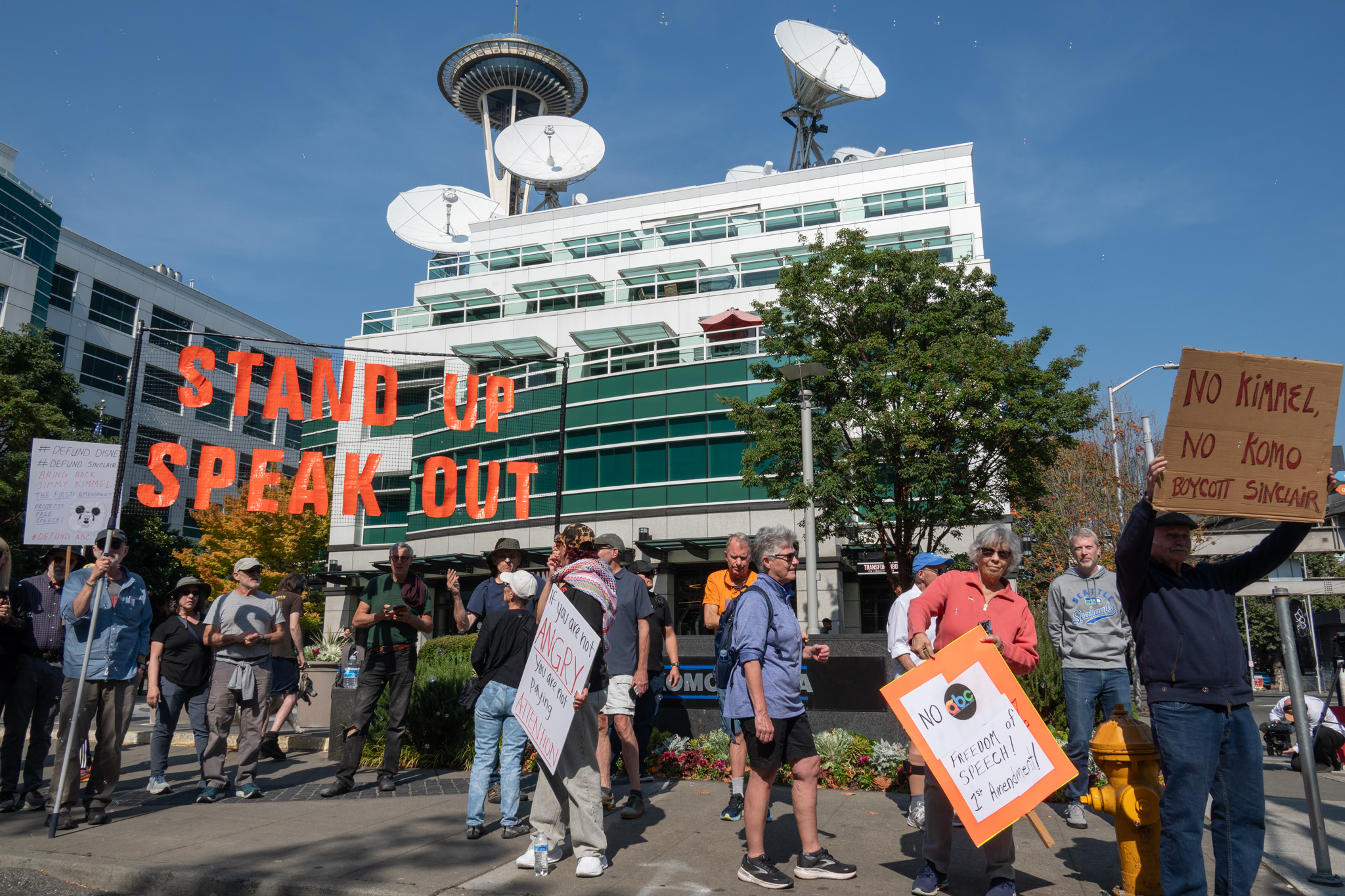
This 2025 protest at Seattle’s KOMO Plaza is a physical manifestation of the 1996 Telecommunications Act’s long-term fallout. While the Space Needle looms in the background, the editorial decisions for this “local” station are often made thousands of miles away at Sinclair Broadcast Group’s headquarters. The “No Kimmel” and “Boycott Sinclair” signs highlight a breaking point for viewers frustrated by corporate “must-run” scripts and the alleged censorship of national programming that criticized the parent company. It is a vivid snapshot of a community realizing that their local news station has been transformed into a relay tower for a national corporate narrative.
The Consolidation of Media Power Timeline In The USA
| Era | Key Player/Law | The "Bad" Result |
|---|---|---|
| 1970s | Nixon & Ailes | Created the "us vs. them" media blueprint. |
| 1987 | Repeal of Fairness Doctrine | Removed the legal requirement to show both sides of an issue. |
| 1988 | Rush Limbaugh | Proved that nationalizing outrage was highly profitable. |
| 1996 | Telecom Act (Section 230) | Gave tech platforms immunity for hosting misinformation. |
| 1996 | Telecom Act (Ownership) | Lifted caps, allowing Nexstar and Paramount to become "too big to fail." |
| 1996 | FOX News Launches | Blurs the line between hard news and partisan opinion. |
| 2000s | Discovery/Heritage | Pushes "Teach the Controversy" to treat science as a debate. |
| 2025 | Skydance-Paramount | Completes the merger of Hollywood production and national broadcast news. |
| 2026 | Nexstar-Tegna Deal | Solidifies one company's dominance over "local" news across the US. |
| Present | X (Twitter) & Meta Platforms | Algorithmic amplification of the most polarized content from the above players. |
The Nixon Administration: The Blueprint (1970s)
The seeds were planted in 1970. Richard Nixon felt the “liberal media” (the big three networks) was unfairly targeting him during the Vietnam War and Watergate.
- The Ailes Memo: A young media advisor named Roger Ailes (who would later lead FOX News) wrote a memo titled “A Plan for Putting the GOP on News.” He argued that the GOP needed its own television network to bypass the “gatekeepers” and speak directly to the base.
- The Strategy: Nixon’s team shifted the focus from policy to cultural grievance, painting journalists as “elites” out of touch with the “Silent Majority.”
The 1980s: The Death of the Fairness Doctrine
If there is a “Big Bang” moment for modern media chaos, it’s 1987. Under the Reagan administration, the FCC repealed the Fairness Doctrine.
- What it was: A rule requiring broadcasters to present controversial issues of public importance in a way that was “honest, equitable, and balanced.”
- The Result: Broadcasters no longer had to provide airtime for opposing views. This paved the way for purely partisan programming without any legal obligation to show “the other side.”
The 90s: Talk Radio & The Limbaugh Effect
With the Fairness Doctrine gone, AM radio, which was dying, found a new life.
-
Rush Limbaugh: Launched nationally in 1988, Limbaugh turned political commentary into high-octane entertainment. He pioneered the “us vs. them” rhetoric, branding mainstream journalists as “State-Run Media.”
-
The Model: He proved that outrage is profitable. If you make people feel like they are part of an exclusive club that knows the “real” truth, they will tune in for hours every day.
The 1996 Telecommunications Act (The Great Consolidation)
This is the “invisible” event that broke the ecosystem. Signed by Bill Clinton, it was the first major overhaul of telecommunications law in 62 years.
-
Lifting the Caps: Before 1996, a company couldn’t own more than 40 radio stations nationally. The Act eliminated the national cap entirely.
-
The Rise of Goliaths: Companies like Clear Channel (now iHeartMedia) went from owning 40 stations to over 1,200.
-
The Death of Localism: To save money, these giants fired local DJs and news reporters, replacing them with syndicated “angry” talk shows from New York or LA. This gutted the “local news” buffer that used to keep communities grounded in shared facts.
-
Cross-Ownership: It allowed companies to own TV stations, radio stations, and newspapers in the same market, centralizing what you heard and read under one corporate board.
The Rise of FOX News (1996)
Roger Ailes finally got to execute his Nixon-era plan. FOX News launched with the slogan “Fair and Balanced”—a brilliant piece of marketing that implied everyone else was biased.
-
Opinion as News: FOX blurred the lines between hard news reporting and evening opinion hosts.
-
Feedback Loops: It created a closed information loop where viewers were told not to trust any information coming from outside the “FOX ecosystem.”
The Intellectual Infrastructure: Heritage & Discovery
While media outlets provided the voice, these organizations provided the content and the tactics.
-
The Heritage Foundation: They pioneered the “Policy Brief” as a media tool. By flooding the zone with pre-packaged talking points, they ensured that conservative pundits always had “data” to cite, even if that data was highly partisan.
-
The Discovery Institute: Known for the “Wedge Strategy,” they sought to challenge the scientific consensus on evolution. More importantly, they perfected the tactic of “Teach the Controversy.” This forced media outlets to treat settled science as a “debate,” creating a blueprint for how to sow doubt about climate change and public health later on.
The Digital Wild West: From Twitter to X and the Meta Monopoly
The internet promised to democratize information, but it ended up destroying the business model of local journalism while amplifying the loudest voices.
-
Algorithmic Outrage: Platforms like X (formerly Twitter) and Meta (Instagram/Facebook/Threads) are designed to reward “engagement.” Nothing engages like anger. The algorithms naturally boosted the most polarizing content from the foundations and outlets mentioned above.
-
The Death of the Gatekeeper: In the Nixon era, you needed a printing press or a tower to reach millions. Now, anyone can. Under Elon Musk’s “X,” the removal of traditional verification and moderation has led to a “post-truth” environment where a bot and a journalist have the same visual authority.
Section 230 of the Communications Decency Act (1996)
The Nexstar-Tegna Acquisition (2026)
Tucked inside the Telecommunications Act was a 26nd-word sentence that changed history.
-
The “Twenty-Six Words”: It stated that “No provider or user of an interactive computer service shall be treated as the publisher or speaker of any information provided by another.”
-
The Immunity Shield: This gave websites (later Facebook, X, and YouTube) legal immunity for what users posted. It allowed the internet to grow, but it also meant platforms had no legal incentive to stop the spread of misinformation or radicalization.
Without the 1996 Telecommunications Act, FOX News and Rush Limbaugh would have just been “niche” players. That law allowed a few corporations to buy up the entire “pipes” of the country, ensuring that the same partisan message was playing in every car and on every local news station from Maine to California.
The result? We lost the “Local Truth” (what’s happening in your city council) and replaced it with “National Grievance” (what a pundit in a studio wants you to be mad about). We see this happening even more under the Trump Administration with companies like Nexstar who would have been legally barred from owning that many stations. The Act removed the “ceiling” that kept the media ecosystem diverse and local.
-
The Move: In March 2026, the FCC approved the transfer of Tegna to Nexstar Media Group.
-
The 1996 Connection: Before the ’96 Act, Nexstar would have hit the “12-station limit” decades ago. Because the Act shifted the focus from the number of stations to a percentage of the national audience (the 39% cap), Nexstar was able to swallow Tegna while staying just under that legal limit (currently owning or operating around 259 stations).
-
The Result: A single board of directors in Irving, Texas, now decides what “local news” looks like for tens of millions of people across nearly every state.
The Skydance-Paramount Merger (2024-2025)
Skydance Media (David Ellison’s company) officially merged with Paramount Global (owner of CBS, MTV, and Nickelodeon) in August 2025.
-
The 1996 Connection: The Act drastically relaxed Cross-Ownership Rules. It used to be much harder for one company to own a major film studio, a broadcast network (CBS), and a massive stable of cable channels simultaneously.
-
The Result: By allowing “convergence,” the Act allowed Paramount to become a massive conglomerate. This made it an attractive target for Skydance. Without the ’96 Act, Paramount would have remained a series of smaller, independent companies rather than a single “content fortress” that a billionaire-backed firm could buy in one go.
How Do We Fix The Fragmentation of Truth in the United States of America?

Solving a problem this deeply rooted requires more than a single law; it requires a complete re-engineering of how we produce, distribute, and fund information. If the 1996 Act was the Great Consolidation, the path forward is the Great Decentralization.
As of early 2026, here is the blueprint of the solutions currently being fought for in courts and legislatures to restore the media ecosystem.
The Antitrust "Hammer": Breaking Up the Giants
The most direct way to fix the Nexstar/Tegna and Skydance/Paramount issues is to stop treating media like any other widget factory.
-
The State AG Counter-Offensive (2026): While federal regulators approved the Nexstar-Tegna merger, eight state Attorneys General (including California and New York) filed a historic lawsuit in March 2026 to block it. Their argument? Federal approval doesn’t override state antitrust laws intended to protect local competition.
-
Reinstating Ownership Caps: There is a growing push to return to pre-1996 levels, where a single company cannot reach more than 25% of the national audience. This would force giants like Nexstar to spin off hundreds of local stations back to local owners.
Reforming Section 230: Liability for "Amplification"
The current debate isn’t about deleting Section 230, but about modernizing it for the age of AI and algorithms.
-
The “Sunset and Renew” Strategy: Proposals in the 119th Congress (2026) suggest that platforms should keep immunity for what users say, but lose it for how the algorithm promotes it.
-
Result: If an algorithm on X or Facebook intentionally boosts a known deepfake or inciting misinformation because it “drives engagement,” the platform would be legally liable for the damage caused, just like a traditional publisher.
The "Community NEWS Act" Model: Funding the Human
If we want to kill “pink slime” (fake local news) and nationalized scripts, we have to make local reporting profitable again.
-
Refundable Tax Credits: California’s Community NEWS Act (AB 2222), currently in hearings (April 2026), provides a blueprint. It offers tax credits to newsrooms for every local journalist they hire.
-
The Logic: Instead of a government “ministry of truth,” the state provides the financial oxygen for independent journalists to exist. If a town has three competing local reporters again, the “National Grievance” model loses its power.
Algorithmic Transparency Laws
In 2026, we are seeing the first real “Right to Know” laws for algorithms.
-
The Frontier AI Acts: New laws in California and Texas now require large platforms to publish their “Frontier AI Frameworks.” This forces companies to disclose how their algorithms prioritize content.
-
Middleware: A popular proposal is to mandate interoperability, allowing you to use a “third-party filter” for your social media feed. Instead of using X’s “Outrage-First” algorithm, you could choose a “Science-First” or “Local-News-First” algorithm created by a non-profit or university.
| Problem | The Fix | Current Status (2026) |
|---|---|---|
| Monopolies | State-level Antitrust Lawsuits | Active: 8 states suing to block Nexstar/Tegna. |
| Outrage Algorithms | Algorithmic Liability (Sec 230 Reform) | Pending: "TAKE IT DOWN Act" signed; new bills in Congress. |
| Dying Local News | Local Journalist Tax Credits | Growing: Passed in NY/IL; pending in CA (AB 2222). |
| Hidden Bias | Transparency & Watermarking Laws | Effective: CA & TX AI Transparency laws began Jan 1, 2026. |
The Final Piece: Media Literacy
None of these laws work if the audience doesn’t know they are being manipulated. Modern “Literacy” isn’t just about reading; it’s about understanding “The Wedge” recognizing when an outlet is trying to turn a settled fact into a “controversy” to keep you watching.
If you want to learn more about media literacy you can over at SaveJournalism.com in one of their handy guides: